

When people talk about artificial intelligence (AI), the conversation usually goes one of two ways. Some believe AI will solve every problem, while others worry it will take away our jobs. But neither view is helpful when you’re at your desk on a Tuesday morning, trying to figure out how to use AI.
After spending over two years studying AI and earning certifications, I’ve come to a simpler conclusion. AI is a tool. The most powerful I’ve seen in my 30 years in this industry. But like any tool, it needs someone to guide it and make sure the work stays on track and accurate.
That distinction matters. When there is a clear role for AI, the technology stops feeling so intimidating. It also gets a lot clearer where your own time and attention belong.
Where AI Earns Its Keep
Look at any week inside a produce company and the work splits two ways. Part of it is the numbers: pulling reports, checking the forecast, pricing the next load, getting the sell sheet out the door. The rest is people: the buyer who needs reassurance, the sales team that isn’t on the same page, and the conversation with a grower that keeps getting pushed to next week.
AI fits best with the numbers, and it does that work well. In fresh produce, this means turning a season’s retail data into something useful for a category manager. It can create a first draft of a sell sheet in minutes instead of days, quickly show what shoppers are looking for, or give a better forecast when weather changes the harvest schedule.
We’ve been here before. When I started selling produce in 1995, the main tools were the phone and fax machine. Later, email, the internet, and smartphones made us faster and better informed. But none of these changed the fact that buyers still want to know who they’re dealing with, and AI doesn’t change that either.
What AI accelerates: research, analysis, first drafts, and the repetitive tasks that eat up a workday.
What stays with people: judgment, relationships, and the decision about what matters most.
The Work That Stays with Us
A great chef’s knife makes dinner faster and cleaner. It does not care whether you are cooking for your family, a dinner party, or yourself at 10 p.m. over the sink. The person holding the knife brings the care.
AI is similar. It can draft an email to a retailer after a rejected load, but the buyer still needs to trust that you’ll fix the problem. AI can summarize a tense team meeting, but only a leader can help two people who clashed find common ground. AI can suggest a strategy, but it’s still up to us to get everyone working together.
That’s the people part, and it’s harder than working with numbers. It can be messy and unpredictable, and it often pushes leaders out of their comfort zones. But this is where the real advantage is. A team that trusts each other and works toward the same goals will achieve more with basic tools than a divided team will with the best technology.
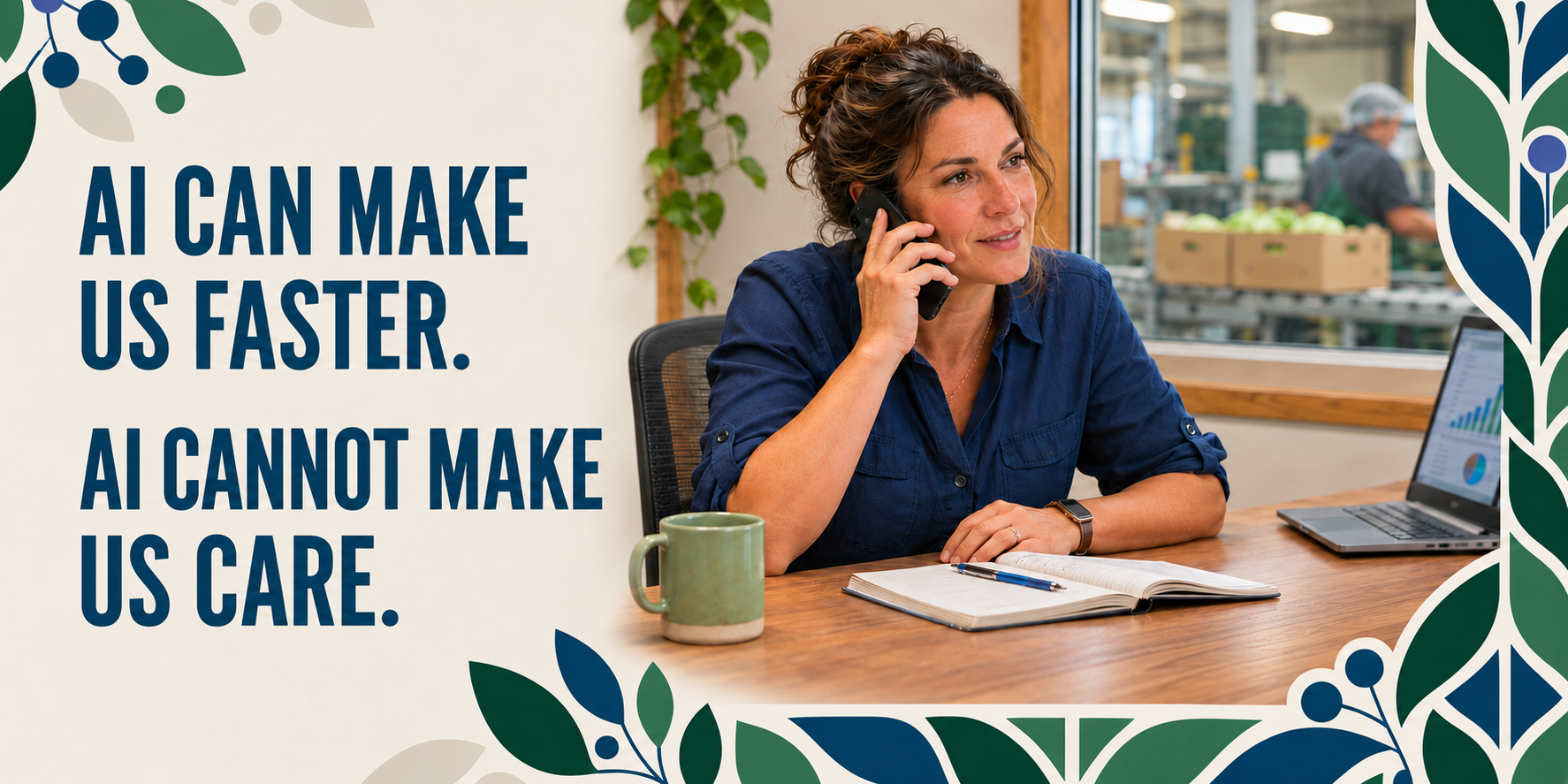
AI can make us faster. AI cannot make us care.
Relationships Still Move Produce
Produce has been, and will continue to be, a people business. Our product is alive, perishable, and at the mercy of the weather. Things go sideways every season. When they do, what holds a deal together is rarely the data. It is the phone call, the history between two people, and the confidence that the person on the other end will do the right thing.
I learned this in sales long before I started DMA. Buyers remember who called them first with bad news. They remember who kept their word on price when the market changed, and who helped them when a load arrived out of spec. No tool can create those moments when trust is built.
The same is true inside our own companies. The growers, shippers, and marketers I respect the most have teams that are open with each other, clear on where they are headed, and invested in the outcome. AI will make those teams even better. Technology will not create that kind of culture for anyone who does not already have it.
So use AI. Start with the harder part: build a plan for using AI responsibly, and make sure your team understands it and follows it. Then learn the tools, test them, and put them to work. Keep AI in its proper place, serving the people and relationships that hold this industry together.
What to Do with the Time AI Saves
This is what excites me most about AI. If AI saves you a few hours of number crunching each week, you get that time back. How you use it is your choice.
Use that time for people. Call the buyer to check in. Walk the packing line. Have the conversation with your team you’ve been putting off. Be considerate, be helpful, and be human.
AI will keep getting smarter. The caring will stay with us, and I think that is where it belongs.